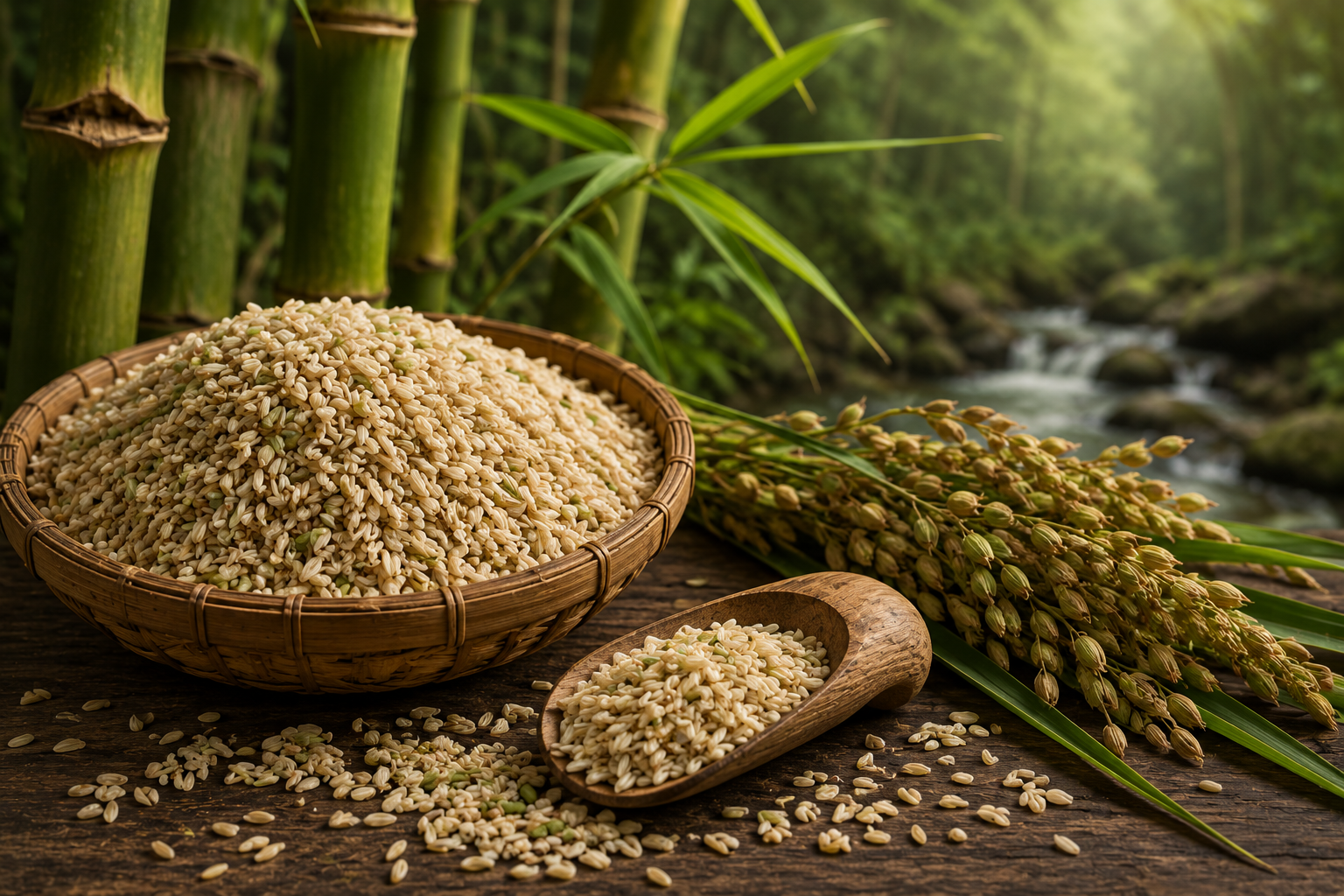
Bamboo rice from Kerala is a rare forest food connected with bamboo flowering, traditional harvesting, and the culinary heritage of communities living in and around Kerala’s forest regions. Unlike conventional rice, bamboo rice comes from the seeds produced by flowering bamboo plants. This unusual origin gives it a distinctive place among Kerala’s traditional foods.
Known locally as Mulayari, bamboo rice has been documented as an ethnic food associated with forest communities. The Kerala Museum of History and Heritage notes that bamboo rice is collected after bamboo flowering and traditionally used for preparations such as porridge and puttu.
For modern consumers, this traditional grain offers more than a different ingredient. It provides an opportunity to explore the relationship between Kerala’s forests, indigenous food knowledge, seasonal harvesting, and traditional cuisine.
Table of Contents
- What Is Bamboo Rice?
- The Origin of Bamboo Rice from Kerala
- How Bamboo Flowering Produces Bamboo Seeds
- How Bamboo Rice Is Traditionally Harvested
- Bamboo Rice and Kerala’s Forest Food Culture
- Traditional Uses of Bamboo Rice
- Bamboo Rice Cooking Methods
- Bamboo Rice Nutrition and What Research Says
- Bamboo Rice from Kerala and Sustainable Food Traditions
- Kerala Naturals Bamboo Rice
- How to Include Bamboo Rice in Modern Meals
- Frequently Asked Questions
- Conclusion
What Is Bamboo Rice?
Bamboo rice is the edible seed produced by certain bamboo plants when they flower. Despite its common name, it is not a conventional rice variety and does not grow in a paddy field.
Bamboo belongs to the grass family, which also includes familiar cereal crops. However, bamboo has a very different reproductive cycle. After a long vegetative period, some bamboo species flower and produce seeds. These seeds can be collected, processed, and used as a grain-like food.
This unusual lifecycle is one reason bamboo seed rice is considered a special forest food. Its availability depends on bamboo flowering rather than annual cultivation.
The exact flowering interval varies among bamboo species, so claims that all bamboo flowers after one specific number of years should be treated cautiously. Research and field records show considerable variation between species and locations.
The Kerala Museum of History and Heritage describes bamboo rice as an exceptionally rare food and documents its traditional collection and use in Kerala.
The Origin of Bamboo Rice from Kerala
The story of bamboo rice from Kerala is closely connected with the state’s forests, particularly regions where bamboo grows naturally.
Kerala contains several forest ecosystems where bamboo occurs in varying densities. The Kerala Forest Department describes bamboo as an important natural resource found across parts of the state’s natural forests and identifies bamboo brakes among Kerala’s forest vegetation types.
Historically, forest-dependent communities have developed detailed knowledge of seasonal plants, edible seeds, roots, fruits, leaves, and other natural resources. Bamboo rice became one part of this broader food tradition.
A KIRTADS journal on changing food habits among Scheduled Tribe communities of Kerala documents bamboo rice as an important ethnic food among communities living inside forests or near forest areas where bamboo clusters are abundant.
The tradition demonstrates how local food systems developed around the natural availability of plants rather than depending exclusively on cultivated crops.
How Bamboo Flowering Produces Bamboo Seeds
The Rare Bamboo Flowering Cycle
Bamboo flowering is central to understanding bamboo rice.
For many bamboo species, flowering is not an annual event. Some species can remain vegetative for many years before flowering. When flowering occurs, bamboo plants produce flowers and subsequently seeds.
These seeds are what people traditionally call bamboo rice.
The process is quite different from conventional rice cultivation. Farmers normally sow rice seeds, grow rice plants, and harvest mature grains during established agricultural seasons. Bamboo seed rice, however, becomes available only when suitable bamboo plants flower and produce viable seeds.
After flowering and seed production, some bamboo species may decline or die as part of their natural lifecycle. Because of this unusual reproductive pattern, bamboo seed availability can be highly seasonal and limited.
Scientific literature also describes bamboo seeds as relatively uncommon because many bamboo species have long vegetative growth periods before flowering.
How Bamboo Rice Is Traditionally Harvested
Collecting the Fallen Seeds
Traditional harvesting methods reflect close observation of the bamboo flowering process.
According to documentation from KIRTADS, communities traditionally cleaned the ground beneath bamboo clusters and placed large leaves or cloth where the seeds could fall. The collected material was then processed to remove the husk.
The Kerala Museum of History and Heritage similarly documents the collection and cleaning of bamboo rice following flowering.
This method is different from harvesting conventional rice, where mature paddy plants are cut and processed using established agricultural machinery or tools.
Traditional bamboo seed collection required patience and knowledge of the forest environment. People needed to recognize flowering bamboo, identify the appropriate collection period, gather the seeds, and process them for cooking.
The process also shows how traditional food systems can make use of naturally occurring resources without requiring conventional farmland.
Bamboo Rice and Kerala’s Forest Food Culture
A Food Connected to Indigenous Knowledge
The cultural importance of bamboo rice cannot be separated from the communities that have traditionally collected and prepared it.
Kerala’s forest-dependent communities have long used a wide range of wild and cultivated foods. Bamboo, in particular, has played multiple roles in traditional life, from food and cooking materials to household and livelihood uses.
The Kerala Forest Department notes that forest-dependent indigenous communities have traditionally relied on forest resources for livelihoods.
Bamboo itself also has an important place in Kerala’s culinary heritage. Traditional cooking practices have included using bamboo stems as cooking vessels and incorporating bamboo into food preparation.
A feature on Kerala’s tribal cuisine describes communities using bamboo stems for cooking rice and other foods, illustrating how bamboo can function as both a food resource and a cooking material.
Bamboo rice therefore represents more than an unusual grain. It forms part of a wider relationship between people, forests, seasonal resources, and traditional culinary knowledge.
Traditional Uses of Bamboo Rice
Bamboo Rice Porridge
One of the traditional uses of bamboo rice is porridge or rice gruel. KIRTADS documentation records its use for preparing rice gruel and other dry edible preparations.
Porridge is a practical way to prepare a grain because additional water produces a soft consistency. Depending on local preferences, it can be served as a simple meal or combined with other ingredients.
Bamboo Rice Puttu
Puttu is another traditional preparation associated with bamboo rice. The Kerala Museum of History and Heritage specifically identifies puttu among the dishes prepared using this forest grain.
This highlights how traditional ingredients can be incorporated into familiar regional cooking techniques.
Bamboo Rice Payasam
Bamboo rice can also be used in sweet preparations. A Kudumbashree publication documents Mulayari Payasam, a bamboo rice or seed kheer associated with Attappady, Kerala. The recipe combines bamboo rice with coconut milk, jaggery, cardamom, and ghee.
This type of preparation demonstrates how a forest ingredient can become part of festive and regional food traditions.
Bamboo Rice Cooking Methods
Bamboo rice can be prepared using methods similar to other grain-based foods, but the exact soaking time, water quantity, and cooking duration can vary.
Basic Cooking Method
Start by rinsing the grains thoroughly to remove loose particles. Soaking before cooking can help soften the grains and support more even cooking.
After soaking, drain the grains and transfer them to a suitable cooking vessel. Add fresh water according to the product’s preparation instructions.
Cook over moderate heat until the grains become tender. Once cooked, allow the rice to rest briefly before serving.
Because bamboo rice products may differ in processing and grain characteristics, it is best to follow the instructions supplied with the particular product.
For recipe inspiration, bamboo rice can be used in simple steamed preparations, porridge, pulao-style dishes, vegetable rice, and traditional sweet dishes.
Bamboo Rice Nutrition and What Research Says
The nutritional composition of bamboo seeds can vary by species, growing conditions, and processing method. Therefore, it is better to use laboratory-tested product information when making specific nutritional comparisons.
Research published in Food Chemistry: X compared bamboo seeds with rice and wheat and found that the tested bamboo seeds contained higher levels of fibre, protein, and certain microelements than the rice and wheat samples studied. The researchers also examined amino acids, fatty acids, and flavonoids.
These findings are interesting, but they should not be interpreted as proof that every bamboo rice product has the same nutritional composition. Different bamboo species can produce seeds with different characteristics.
Another study examining bamboo seeds found differences in soluble protein, soluble sugars, starch, and mineral elements compared with rice and wheat. It also highlighted the need for careful assessment of mineral accumulation because some bamboo seeds studied showed higher concentrations of certain heavy metals.
For this reason, consumers should choose properly processed and quality-tested food products and avoid making broad health claims based solely on traditional descriptions or research on a different bamboo species.
Bamboo Rice from Kerala and Sustainable Food Traditions
The story of bamboo rice from Kerala also raises important questions about responsible harvesting.
Forest foods are closely connected with their ecosystems. Sustainable collection matters because excessive harvesting or careless disturbance can affect both the plant population and the surrounding habitat.
The Kerala Forest Department emphasizes the importance of sustainable management of bamboo resources in the state.
Traditional communities often possess detailed knowledge of when and how natural resources can be collected. Preserving this knowledge while supporting responsible sourcing can help protect both cultural heritage and natural resources.
For consumers, choosing products that provide clear information about sourcing, processing, and quality can be one practical way to support responsible food systems.
Kerala Naturals Bamboo Rice
For consumers interested in trying this traditional grain, Kerala Naturals Bamboo Rice is listed as 100% natural wild forest brown bamboo rice sourced from the Western Ghats. The product is offered as a 500-gram pack and is described as being carefully and hygienically packed.
The product page also describes bamboo rice as Mulayari and identifies it as a seed produced during the bamboo plant’s later lifecycle.
Readers interested in Kerala’s wider traditional food culture can also explore Kerala Naturals’ traditional food products article for related information about ingredients and food practices connected with Kerala.
How to Include Bamboo Rice in Modern Meals
Traditional ingredients do not need to remain limited to traditional recipes. Bamboo rice can be adapted to modern home cooking while retaining its distinctive character.
Simple Grain Bowl
Cooked bamboo rice can form the base of a grain bowl with roasted vegetables, legumes, leafy greens, and a simple dressing.
Vegetable Pulao
Bamboo rice can also be used in a vegetable pulao. Combine cooked or partially cooked grains with vegetables, onions, herbs, and mild spices for a satisfying meal.
Breakfast Porridge
A soft bamboo rice porridge can be prepared with additional water or milk, depending on the recipe. Sweet versions can use coconut milk, jaggery, and cardamom, while savoury versions can include vegetables and mild spices.
Traditional Kerala Meal
For a regional approach, serve cooked bamboo rice with vegetable preparations, lentils, coconut-based curries, or other familiar Kerala accompaniments.
These options make it easier to explore bamboo seed rice without changing the entire structure of an everyday meal.
Why Bamboo Rice Remains Relevant Today
Interest in traditional foods has grown as consumers look beyond familiar grains and explore regional food heritage.
Bamboo rice offers a particularly interesting story because its availability depends on a natural event rather than routine annual cultivation. It connects the dining table with bamboo forests, seasonal cycles, indigenous knowledge, and regional cuisine.
At the same time, traditional foods should be understood realistically. Bamboo rice is not a substitute for a varied diet, and traditional claims about health should not automatically be treated as established medical facts.
Its greatest value may be the combination of culinary diversity, cultural heritage, and the opportunity to appreciate lesser-known foods from India’s forest landscapes.
Frequently Asked Questions
Is bamboo rice actually rice?
No. Bamboo rice is the edible seed produced by flowering bamboo plants. It is called rice because the seeds are grain-like and can be cooked and eaten in ways similar to rice.
What is bamboo rice called in Kerala?
Bamboo rice is commonly known as Mulayari in Kerala. The term is associated with the bamboo seed used as a food.
Where does bamboo rice from Kerala come from?
It is associated with bamboo-growing forest regions of Kerala, including areas of the Western Ghats. Historical and cultural documentation records its use among forest and forest-fringe communities.
How is bamboo rice collected?
Traditionally, the ground beneath flowering bamboo clusters can be cleaned and covered with leaves or cloth so that falling seeds can be collected. The seeds are then cleaned and processed.
What can you make with bamboo rice?
Bamboo rice can be used for porridge, puttu, payasam, cooked rice dishes, pulao-style preparations, and other grain-based meals.
Is bamboo rice nutritionally different from regular rice?
Research comparing particular bamboo seed samples with rice and wheat has found differences in fibre, protein, minerals, and other components. However, the nutritional profile varies by bamboo species and sample, so product-specific nutrition information is preferable.
Conclusion
Bamboo rice from Kerala represents a fascinating connection between forests, food, and cultural heritage. Produced from the seeds of flowering bamboo rather than conventional paddy, it has a unique natural lifecycle and a long-standing place in the food traditions of Kerala’s forest communities.
From traditional porridge and puttu to payasam and modern grain-based meals, bamboo rice demonstrates how naturally occurring forest foods can become part of regional cuisine. Its story also highlights the importance of indigenous knowledge, seasonal harvesting, responsible sourcing, and sustainable management of forest resources.
For anyone interested in traditional Kerala foods, bamboo rice offers an opportunity to discover a lesser-known ingredient with a remarkable journey from flowering bamboo to the kitchen. Understanding its origin and traditional uses allows this unusual grain to be appreciated not only as a food but also as part of Kerala’s rich culinary and ecological heritage.
External Resources
- Kerala Museum – Ethnic Food – Traditional information on bamboo rice, its collection, and culinary uses.
- Kerala Forest Department – Flora of Kerala – Information about bamboo and Kerala’s forest ecosystems.
- PubMed – Bamboo Rice Nutritional Study – Research on the nutritional properties of bamboo seeds.
- KIRTADS – Tribal Food Practices – Research documenting traditional food practices involving bamboo rice.